Autosomal Dominant

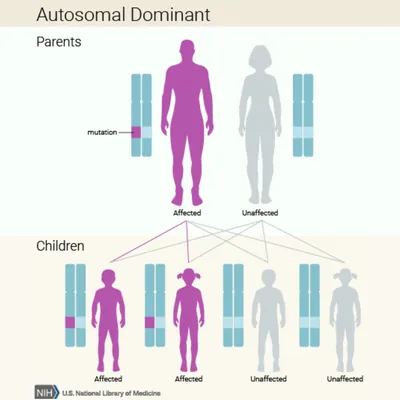
People affected by an autosomal dominant disease have a 50% chance of passing on the mutated gene to their biological child.
Learn more about inheritance patterns from the National Library of Medicine (NLM).

Many rare diseases have limited information. Currently, GARD aims to provide the following information for this disease:
A biological parent can sometimes pass down genetic changes, called mutations, that cause a disease or increase the chances of developing it. This is called inheritance. Knowing if other family members have had the disease, also known as your family health history, can give your medical team important information. The Surgeon General offers a tool to help you collect your family health history.

7 Symptoms
7 Symptoms

If a diagnosis remains unclear, visiting a multidisciplinary care center or university hospital may help. These centers bring together teams of specialists who can work together to evaluate symptoms and coordinate a diagnosis. This team-based approach is also helpful after a diagnosis, when managing care for rare diseases.
Because only about 5% of rare diseases have FDA-approved treatments, finding the right healthcare team to manage your symptoms and overall health is essential. People living with rare diseases often face challenges such as delayed diagnosis, limited treatment options, and difficulty accessing knowledgeable providers. Building a care team that understands your needs can make a significant difference in your quality of life.


Building the right health care team is key to the diagnosis, treatment, and management of your long-term health journey living with a rare disease. Start by choosing a primary care provider (PCP). Your PCP will be your main point of contact and help coordinate care with other medical professionals. Your PCP may order tests or refer you to specialists. To find a PCP near you, use the Medicare provider search tool and enter your location and “Primary Care Provider.”
Seeing multiple specialists is important for people with rare diseases because these conditions often affect many parts of the body and require care from doctors with different expertise. Most primary care providers may not be familiar with rare diseases, so involving specialists can lead to a more accurate diagnosis and better care. A coordinated team approach ensures that all symptoms are addressed and that care is well-managed. It can also connect patients with the latest research or treatment options.

If you've visited your PCP, met with specialists, and undergone the recommended tests, but are still searching for a diagnosis, it may be time to visit an academic medical center or, for pediatric patients, a children's hospital. Academic medical centers and children's hospitals, often called multidisciplinary care centers, typically bring together specialists from different fields to work together on complex cases like rare diseases.
Multidisciplinary care centers may offer more coordinated care and be involved in clinical research, which may help reduce the time to diagnosis and provide access to emerging diagnostic tools. Specialists at these centers may have a deeper understanding of rare diseases and serve as a resource when you'd like a second opinion, particularly when test results or treatment plans are not delivering expected results.
Use this tool to find hospitals that may partner with medical schools and programs in your area.

If you've visited your PCP, met with specialists, and undergone the recommended tests, but are still searching for a diagnosis, it may be time to visit an academic medical center or, for pediatric patients, a children's hospital. Academic medical centers and children's hospitals, often called multidisciplinary care centers, typically bring together specialists from different fields to work together on complex cases like rare diseases.
Multidisciplinary care centers may offer more coordinated care and be involved in clinical research, which may help reduce the time to diagnosis and provide access to emerging diagnostic tools. Specialists at these centers may have a deeper understanding of rare diseases and serve as a resource when you'd like a second opinion, particularly when test results or treatment plans are not delivering expected results.
Use this tool to find hospitals that may partner with medical schools and programs in your area.
If a diagnosis, care management, or treatment plan remains unclear despite extensive efforts by your PCP and specialists, it may be time to find a rare disease expert for your disease, if available. A rare disease expert is a medical provider that has knowledge or training on specific rare disease(s), but there may only be a few experts in your state, region, or country. Rare disease experts may work at large research or teaching hospitals, sometimes called centers of excellence. Centers of Excellence commit to sharing knowledge and best practices that can lead to improved care and treatment for individuals living with a rare disease.
You can also contact a GARD Information Specialist for help finding experts, centers of excellence, or clinics that focus on your disease.


If a diagnosis, care management, or treatment plan remains unclear despite extensive efforts by your PCP and specialists, it may be time to find a rare disease expert for your disease, if available. A rare disease expert is a medical provider that has knowledge or training on specific rare disease(s), but there may only be a few experts in your state, region, or country. Rare disease experts may work at large research or teaching hospitals, sometimes called centers of excellence. Centers of Excellence commit to sharing knowledge and best practices that can lead to improved care and treatment for individuals living with a rare disease.
You can also contact a GARD Information Specialist for help finding experts, centers of excellence, or clinics that focus on your disease.
Patient organizations can help patients and families connect. They build public awareness of the disease and are a driving force behind research to improve patients' lives. They may offer online and in-person resources to help people live well with their disease. Many collaborate with medical experts and researchers.
Services of patient organizations differ, but may include:
Please note: GARD provides organizations for informational purposes only and not as an endorsement of their services. Contact a GARD Information Specialist for more information on organizations that may be dedicated to this disease. Please contact an organization directly if you have questions about the information or resources it provides.
View GARD's criteria for including patient organizations, which can be found under the FAQs on our About GARD page. Request an update or to have your organization added to GARD.


5 Organizations
Organization Name
Who They Serve
Helpful Links
Country
Retinal cone dystrophy 3a
United States
Clinical studies are a part of clinical research and play an important role in medical advances for rare diseases. Through clinical studies, researchers may ultimately uncover better ways to treat, prevent, diagnose, and understand human diseases.

Clinical studies are medical research involving people as participants. There are two main types of clinical studies:
Learn more about clinical trials from this National Institutes of Health webpage.
People participate in clinical trials for many reasons. People with a disease may participate to receive the newest possible treatment and additional care from clinical study staff as well as to help others living with the same or a similar disease. Healthy volunteers may participate to help others and to contribute to moving science forward.
To find the right clinical study we recommend you consult your doctors, other trusted medical professionals, and patient organizations. Additionally, you can use ClinicalTrials.gov to search for clinical studies by disease, terms, or location.
ResearchMatch helps connect people interested in research studies with researchers from top medical centers across the United States. Anyone from the U.S. can register with this free program funded by NIH. Researchers from participating institutions use the database to search for and invite patients or healthy volunteers who meet their study criteria to participate.
The All of Us Research Program is inviting 1 million people from all backgrounds across the U.S. to help build one of the most diverse health databases in history. Researchers will use the data to learn how our biology, lifestyle, and environment affect health. This may one day help them find ways to treat and prevent diseases.
Learn more about clinical trials from this National Institutes of Health webpage.
ResearchMatch helps connect people interested in research studies with researchers from top medical centers across the United States. Anyone from the U.S. can register with this free program funded by NIH. Researchers from participating institutions use the database to search for and invite patients or healthy volunteers who meet their study criteria to participate.
The All of Us Research Program is inviting 1 million people from all backgrounds across the U.S. to help build one of the most diverse health databases in history. Researchers will use the data to learn how our biology, lifestyle, and environment affect health. This may one day help them find ways to treat and prevent diseases.
GARD collects data from a variety of sources to populate its website and provide accurate and reliable information on rare diseases.
GARD uses data collected from Orphanet, Online Mendelian Inheritance in Man (OMIM) , and Mondo Disease Ontology to interpret and provide information on rare diseases. This includes names, synonyms, genes, symptom frequency, population estimates and more.
GARD uses the Human Phenotype Ontology (HPO) for standard terminology to represent a disease's phenotypic and clinical features.
GARD uses information gathered from the National Center for Biotechnology Information's MedGen to help in explaining genetic and rare diseases.
GARD uses the National Library of Medicine for a variety of resources on health information.
GARD uses additional resources when developing content.
Last Updated: September 2025